
Nisha M. Pillai
Assistant Research Professor | Machine Learning, Computer Vision, NLP
Mississippi State University · Bagley College of Engineering
My research addresses core problems in machine learning, computer vision, spatio-temporal modeling, and natural language processing. A common thread across all of my work is building AI systems that learn reliably from limited or noisy data, produce outputs that domain experts can understand and act on, and remain robust when deployed outside controlled settings. I validate my methods on high-impact problems in disease surveillance, environmental monitoring, health, and language understanding. Current and pending federal funding includes proposals to USDA NIFA, NSF, and NIH spanning machine learning, trustworthy AI, and multimodal health systems.

Across all of this work, my guiding principle is that the value of an AI system is measured not by model performance alone, but by whether a domain expert can understand and act on what it tells them.
Research Interests
Computer Vision
Natural Language Processing
Explainable AI
Spatio-Temporal Modeling
Human-Robot Interaction
Generative Modeling
Robotics
AI for Health
Research Experience
Assistant Research Professor — Machine Learning, Computer Vision, NLP, Spatio-Temporal Modeling
Mississippi State University · April 2024 – Present
- Guiding collaborative investigation into neuroimaging and language processing biomarkers for brain aging.
- Designing computer vision architectures for animal monitoring in resource-constrained environments.
- Collaborating with Civil Engineering on ML methods for identifying job satisfaction factors.
- PI on research proposals to USDA and NSF across agriculture, NLP, wireless systems, and security.
- Mentoring graduate and undergraduate students across security, software engineering, CV, and NLP.
Research Scientist I — Deep Learning, Machine Learning
Mississippi State University · Feb 2023 – April 2024
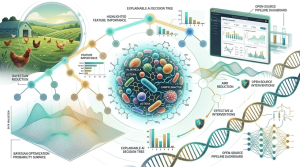
- Developed data-driven frameworks for identifying microbiome signatures predictive of reduced multidrug resistance.
- Built open-source end-to-end ML pipeline for non-programmers to analyze complex biological data.
Post-doctoral Associate — Graph Neural Networks, Deep Learning
Mississippi State University · Sep 2021 – Jan 2023
- Developed GNN-based systems to analyze factors affecting infection rates in pasture-raised poultry.
- Designed ensemble framework to predict physicochemical soil/fecal parameters influencing pathogen prevalence.
- Collaborated on Cyber-Physical security surveillance framework using digital twin anomaly detection.
Research Assistant — ML, NLP, Robotics
UMBC · May 2016 – Aug 2021
- Designed language learning systems jointly learning linguistic concepts and visual percepts via probabilistic algorithms.
- Proposed unsupervised GMM-based active learning approach reducing annotation data by 5% across complex settings.
- Developed category-free unsupervised deep generative VAE with minimum grounding score of 0.45 (baseline <0.1).

